
 support@nursingpaper.com
  Log In


Write Your Nursing Research Question Paper, Using the Best Techniques
Wondering what a nursing research question paper is and how to write it successfully? Do not fret....
December 10, 2025



When high school students think about a career in medicine, they browse different specializations and degrees. Nursing attracts numerous graduates. This field offers highly required research professions like nursing essay writers and opportunities for treating patients. Many medical school applicants wonder, “What does DNP stand for in nursing?” and they simply Google the abbreviation. Doctor of nursing practice is the correct answer.
However, what is a DNP in nursing, and why is it so important? The answer to the question, “What does DNP stand for?” is Doctor of Nursing Practice. Every career has a top position. Doctorate belongs to this category. A doctorate degree focuses on raising leaders who will become key figures in the healthcare system. DNP workers possess tremendous clinical experience and knowledge. Such nursing practitioners can effectively manage shifts, achieving top results.
New AACN (American Association of Colleges of Nursing) updates for 2024–2025 emphasize that the DNP is now the recommended entry-to-practice degree for several APRN roles, as the profession shifts toward doctoral-level preparation for advanced practice.
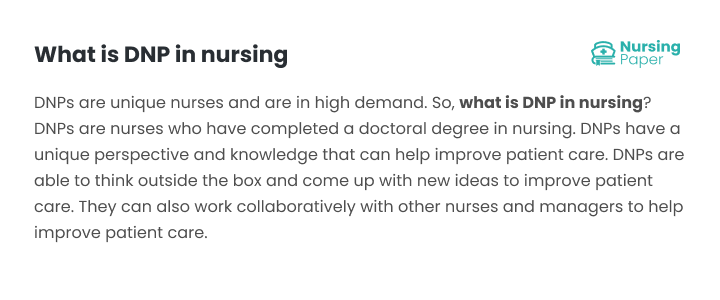
If you want to get the answer to the question “What does DNP stand for in nursing?” you should know that medical school students often confuse a DNP degree with just a role. Hospitals cannot just assign it. You must obtain a nursing practitioner doctorate by passing certified exams. Preparation for tests requires gaining real-world experience and increasing knowledge of nursing disciplines. Students can simultaneously study for advanced practice registered nurses, too. APRN training allows mastering specializations like a midwife, anesthesiologist, clinical nurse expert, etc.
Doctor of nursing practitioners commonly take responsibility for:
Many fellowships students wish to obtain DNP due to good salaries. However, it greatly varies. Beginners without much experience may receive even less than NP graduates. After some working period, doctoral nursing practitioners can qualify for higher pay. The difference between minimal and maximal salaries on the labor market for such a position is significant.

If you want to get a clear answer to “What does DNP stand for in nursing?” you should know that many students mistakenly think DNP is a role or job title. It is not something a hospital can assign — it is an earned doctoral degree that requires completing an accredited program and passing relevant certification exams.
Preparation includes:
Students may train simultaneously for advanced practice registered nurse (APRN) roles, including nurse midwife, nurse anesthetist, nurse practitioner, and clinical nurse specialist.
Doctor of Nursing Practice professionals commonly take responsibility for:
Many fellowship students wish to obtain a DNP due to strong long-term salaries. However, income varies depending on location, experience, and specialization.
In 2025, nurse anesthetists (CRNAs with DNPs) remain among the highest-paid nursing professionals, and several states now require doctoral preparation for entry into practice. Salary growth is also influenced by telehealth expansion, primary care shortages, and full practice authority laws.
A DNP stands for Doctor of Nursing Practice — a doctoral degree in advanced clinical nursing education.
As of 2025, the DNP is recognized as the terminal practice-focused degree, while the PhD remains the terminal research-focused degree. The DNP prepares nurses to translate evidence into practice, lead healthcare teams, and improve patient-care systems.
While many doctoral degrees emphasize academic research, the DNP focuses on clinical excellence, healthcare leadership, and evidence-based practice innovations. APRNs and nursing leaders pursue the DNP to advance their careers and improve clinical care delivery.
Many misconceptions surround the DNP medical abbreviation, often leading to misunderstandings about its purpose. There is great confusion concerning a DNP being just like a PhD in nursing because both are terminal degrees. The truth is they differ greatly because a doctorate degree in nursing (DNP) has an emphasis on the clinical aspects, while a PhD concerns research and academics.
Without advanced education, it is difficult to secure high-level clinical roles. Professions related to patient health require formal licensure and training. To become a doctoral nursing practitioner, students must complete a DNP program.
Starting in 2025, most accredited programs require:
Modern DNP programs are increasingly flexible. Many institutions offer online or hybrid formats, part-time options, and employer-supported tuition pathways.
Types of DNP programs:
Students choose a specialization such as family nurse practitioner, pediatric care, psychiatric-mental health, midwifery, anesthesia, or organizational leadership.
DNP programs now commonly integrate simulation labs, virtual patient care modules, and AI-supported diagnostics training to reflect modern clinical environments.
Many misconceptions surround the DNP abbreviation.
Myth 1: “A DNP is basically a PhD.”
Not true — a PhD focuses on scientific research, whereas the DNP focuses on clinical practice and healthcare leadership.
Myth 2: “A DNP is just a title.”
DNPs lead healthcare organizations, design policy initiatives, and drive quality improvement.
Myth 3: “DNPs cannot practice independently.”
In many U.S. states, DNP-prepared APRNs have full practice authority, enabling them to diagnose, treat, and prescribe medications without physician oversight.
Myth 4: “A DNP isn’t necessary if you already have an MSN.”
The DNP offers advanced expertise in leadership, evidence-based practice, and technological innovation.
Due to nationwide physician shortages, especially in primary care and rural health, DNP-prepared nurse practitioners are increasingly essential providers in underserved communities. The American Association of Nurse Practitioners notes a consistent rise in independent NP practices across full-practice-authority states.
While checking ahead what degrees you can obtain in the end, you find out that nursing offers two degrees. The first is the doctorate of philosophy. The second is the doctorate of nursing practice. Each one belongs to an advanced category of education than other degrees. Still, you should not confuse them.
So what is the difference between a DNP and a PhD in nursing sphere? With each degree, you can take a position of a nursing practitioner. Meanwhile, the main peculiarity of DNP vs PhD in nursing is the work specification. While DNP students focus on patient treatment and practical work, PhD graduates will mostly deal with medical researches.
Both degrees are crucial for medicine. While nursing practitioners gather data on patients, illnesses, and symptoms, scholars analyze materials trying to develop new treatment methods. Besides, PhD holders can conduct classes and give lections. Most programs include obligatory teaching hours. In the end, you will have to write a large scientific dissertation too.
Doctor of philosophy graduates has many options for further occupations. They can work in laboratories, researching different cures. PhD experts often lead scientific teams, studying chronic illnesses and finding new treatments. If students imagine themselves as great laboratory experts, who deal with the rarest and newest diseases, not just DNP capstone project writers, a PhD degree may suit them.
Another application for the doctor of philosophy diploma occupies an important position in the country’s healthcare system. Numerous spheres of providing medical treatment require reformations and innovations. With enough knowledge, you can help numerous patients. Thus, choose a nursing degree, which matches your personal preferences.