

 support@nursingpaper.com
  Log In


Write Your Nursing Research Question Paper, Using the Best Techniques
Wondering what a nursing research question paper is and how to write it successfully? Do not fret....
December 10, 2025



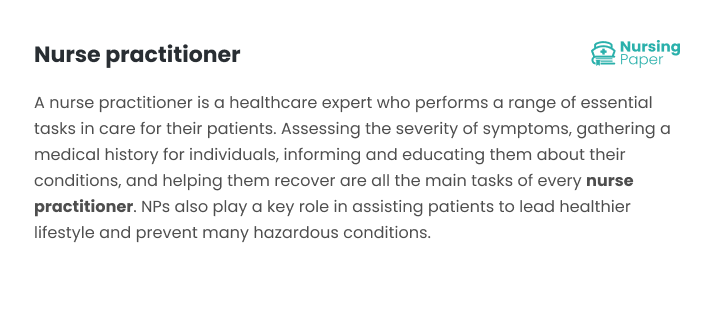
What is a nurse practitioner job? Nurses are known to give a variety of healthcare services to patients and help in many types of cases. To be precise, what does nurse practitioner do? When working as a nurse practitioner, you will typically have the following responsibilities:
Hence, the roles played by nurse practitioners are very significant and responsible – look at these nurse practice act essay examples to discover about the RN nurse role. Going through other samples from the database, you also understand why nursing is one of the fastest-growing areas of medicine in the US. However, the profession also demands high flexibility.
With so many types of nursing degrees and certifications, one may reasonably be left wondering, “what does a NP do?” While we have covered the NP’s core scope of responsibilities above, it also makes sense to look at what NPs don’t do. The list of activities that only doctors can perform and NPs are not allowed to are:
With this information at your fingertips, you’ll probably have no more issues with the question, “What does a nurse practitioner do?”
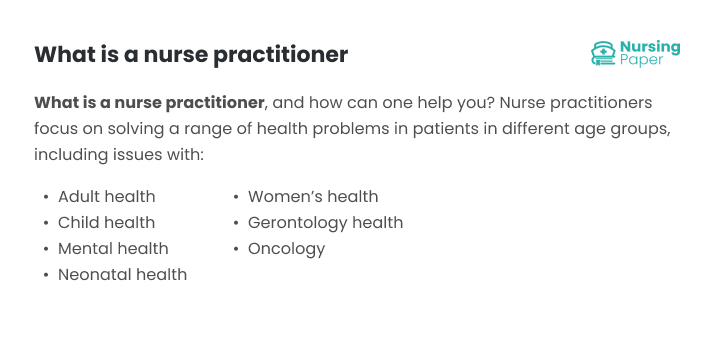
As a rule, nurse practitioners work in different environments: hospitals, patient homes, private medical offices, schools and colleges, labor centers, mobile and community clinics, etc. They can as well go beyond these and offer services at home. Check out these nurse practitioner essay examples to learn more about some of their responsibilities and capabilities.
In 2025, more states have expanded full practice authority for nurse practitioners, allowing them to evaluate patients, diagnose conditions, and prescribe medications independently without physician oversight. This shift particularly benefits rural and underserved regions where access to physicians remains limited. As a result, NPs now play an even larger role in primary care delivery, chronic disease management, and community-based health initiatives.

Despite the broad spectrum of responsibilities and functions of a nurse practitioner, it needs further clarification, such as what exactly makes the profession stand out and differ from the role of physician assistant.
They both are healthcare professionals who may seem to carry similar services. They both can diagnose patients and write our prescriptions and need board certification and training. However, the paths to achieving the qualifications are quite different.
So, what is the difference between nurse practitioner and physician assistant? Here are the main points setting physician assistants (PAs) apart:
Thus, unlike NPs, physician assistants are educated in general medicine, don’t focus on a special medical field, and do not hold practice authority apart from a physician. A nurse practitioner degree, however, doesn’t enable them to change practice areas easily and instead needs them to obtain new specialty certification.
Recent healthcare trends show a growing emphasis on collaborative care models. Although NPs and PAs differ in education and legal authority, many clinical environments—especially outpatient centers and urgent care clinics—now integrate both roles into unified care teams. This approach helps reduce patient wait times, improves chronic disease management, and supports hospitals facing nationwide staffing shortages.
Now, what degree do you need for a nurse practitioner job? Nurse practitioners can be of different types: Registered Nurses (RNs) and Advanced Practice Registered Nurses (APRNs). The second is reached when a person gets an advanced degree. A nurse practitioner must earn at least a master’s degree and undergo training to receive a nursing license. Oftentimes a higher degree, such as a doctoral, is needed.
Anyone targeting this career needs to follow several steps:
The first and most fundamental step in pursuing a career as an NP is achieving a degree. Getting one means you will not only be able to apply for a license but will be well-versed in the necessary medical knowledge.
A degree like an associate degree in nursing (ADN), bachelor of science in nursing (BSN), or diploma are common. A BSN usually allows a nurse practitioner to cover more credits and get deeper into a chosen field, so it is often recommended.
If you haven’t reached a BSN, think of an appropriate bachelor’s program to enroll in. A great plus will have an ADN – with this degree, and one can start a BSN program. Many of such nurse practitioner programs are available online.
However, bridge programs are becoming increasingly popular solutions as they allow you to cover BSN and DNP right away after the ADN, skipping the bachelor’s degree. This means accelerated professional growth.
As a rule, a young nurse practitioner must gain some work experience after a bachelor’s degree. This period falls on the time between getting a bachelor’s diploma and a graduate degree such as a master of science in nursing (MSN) or doctor of nursing practice (DNP).
Next, there is an advanced degree to get apart from the basic one you already have. They are master of nursing science (MSN) and doctor of nursing practice (DNP). The latter is the highest level of education for practitioner nurse.
Exams allow you to prove the knowledge you obtained during years of study and move on toward licensing as a nurse practitioner. All RNs have to pass National Council Licensure Examination and a certification exam in the chosen profile area.
Being licensed by the state opens up doors for professional practice. Applying for a license includes a series of steps:
These are the nurse practitioner requirements in a nutshell.
Many universities now offer accelerated BSN-to-DNP tracks and hybrid NP programs that blend online coursework with localized clinical placements. These programs are designed for working RNs who need flexibility while advancing their education. Fast-track pathways shorten the overall timeline to becoming an NP and are increasingly supported by employers through tuition reimbursement and paid clinical hours.
When running for a career as a nurse, one should get ready to spend 6 to 9 years on education alone. This study time is required to fulfill a bachelor’s, master’s, or doctoral program. Still, everything depends on your starting point – the degree and additional qualifications you already hold.
However, as mentioned above, the answer to ‘How long does it take to become a nurse practitioner?’ can be a bit different. For example, some NPs start working with patients after graduating from accelerated education programs that last nearly 2 years. Still, in most cases, a nurse practitioner would need a master’s degree to move up the ladder and find more opportunities.
The timeline can be shorter for experienced RNs—especially those with prior certifications such as CCRN, CPN, or emergency nursing credentials. Many programs now grant academic credit for clinical experience, reducing the amount of coursework required. As a result, some working nurses complete an MSN NP track in as little as 18–24 months.
‘How much does a nurse practitioner make?’ is another essential question for anyone pursuing this path? A nurse’s salary depends on several factors. They include:
Salaries can vary a lot based on location. Cities with millions of inhabitants offer a more competitive year’s salary than countryside areas. Still, an average yearly nurse’s salary across the US has been estimated at $115,800. States located in far-fetched regions tend to pay less to medical workers. E.g., Alabama’s nurses get paid only $99,570, whereas those lucky enough to practice in NY get $120,000 and up.
A number of applicable certifications and their levels plays an enormous role. For example, nurses with doctoral degrees are usually welcome in most high-paying vacancies, which isn’t true for every bachelor’s degree holder.
Your salary will be different depending on whether you practice in a hospital, governmental or private institution, or a mobile clinic. As a rule, private practices offer more generous earnings for nurse practitioners than average American hospitals.
Due to the ongoing national shortage of primary care providers, NP salaries have risen steadily in 2024–2025. Specialties such as psychiatric mental health, neonatal care, and acute care command some of the highest salaries, often exceeding $150,000 annually in major metropolitan areas. Telehealth positions have also expanded, offering competitive pay and full-remote flexibility for experienced NPs.
The topic of nurse practitioner education is wider to fit into one paragraph. So, there is more to know about nurse practitioner schooling. This is the key answer to how to become a nurse practitioner so let’s delve in.
If you’re in doubt about what higher level of education to pick, consider the peculiarities and differences between a master of nursing science (MSN) and a doctor of nursing practice (DNP).
In America, students receiving an MSN nursing degree are trained to deal with patients and provide care in the most practical aspects. If your goal is not only lifelong learning (which has a big role in both qualifications and after graduating, too), think of DNP. As a doctor of nursing practice, you will be more seasoned in healthcare research. That is why it is the highest level one can reach.
Earning both degrees takes 3 to 5 years and will definitely pay off in the future, as well as come in handy with the knowledge and skills they help to build up.
P.S. If getting a doctorate looks like a huge challenge because of lots of research and academic tasks, use the official and reputable DNP writing services.
Modern NP programs increasingly incorporate coursework in health policy, informatics, and population health management. This shift prepares graduates for leadership roles in hospital administration, quality improvement, and digital health innovation. DNP students, in particular, now complete capstone projects that directly address real-world healthcare problems such as reducing readmissions or improving telehealth access.
What exactly is a nurse practitioner specialization, and what professional areas are open for NPs with a degree? Before delving into the best education programs, let’s see the most popular areas that nurses these days focus on.
If any of these seems like your vocation, don’t hesitate and take action to land the nurse practitioner job.
As healthcare evolves, several emerging NP specialties are gaining traction, including Integrative/Functional Medicine NP, Telehealth NP, Population Health NP, and Oncology Navigation NP. These roles reflect the changing needs of the healthcare system and offer exciting career pathways for nurses interested in preventive care, digital health, and long-term patient support.
For illustration and informing you about what education is worth. Here are some top programs to take for a family practitioner.
All programs are offered online and in person and offer all it takes to provide excellent primary care to patients of all ages. They prepare you for advanced clinical practice, including perinatal and pediatric practice, as well as help to promote a healthy lifestyle and educate patients in versatile ways. The tuition is worth $1,800 per academic credit on average.
The U.S. Bureau of Labor Statistics projects the NP profession to grow by more than 38% through 2032, making it one of the fastest-growing healthcare roles. Demand is especially high in mental health, geriatrics, family practice, and acute care settings. With expanding autonomy and competitive salaries, 2025 continues to be an excellent year for launching a nurse practitioner career.